
Managing Childhood: Therapy, Family Court, and the Illusion of Care
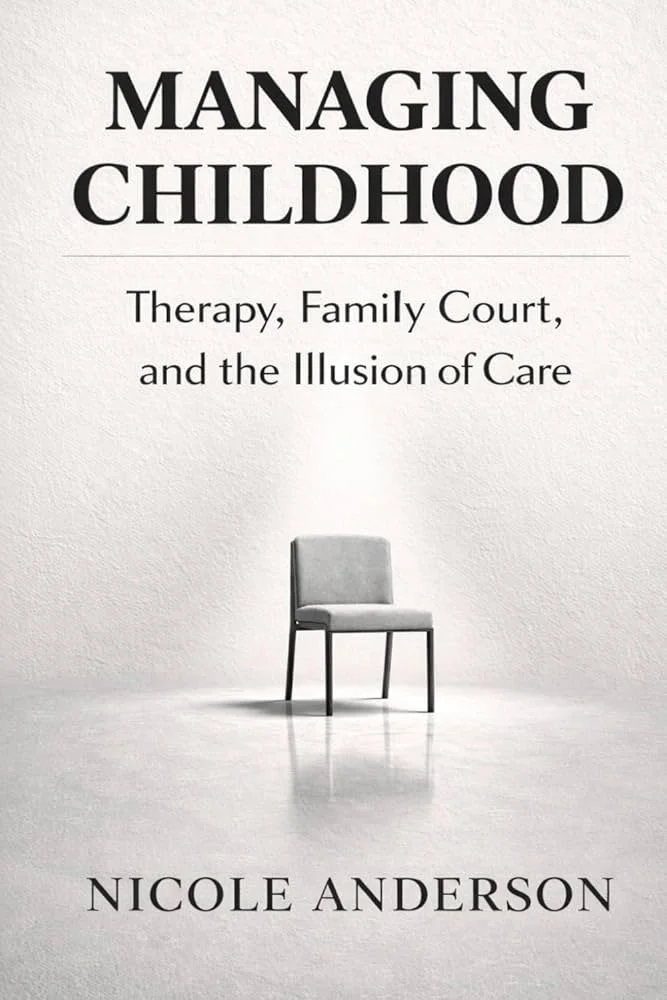
Nicole Anderson | English, 2026
Family court cases are often described as unique.
Each decision is said to turn on its own facts, personalities, and circumstances.
This book asks a different question.
What happens when the same outcomes appear across cases that share no actors, no jurisdictions, and no explicit coordination?
Rather than focusing on individual wrongdoing, this book examines the structure of court-involved family systems, how therapy, professional language, concern, time, and interpretation interact to produce predictable results without ever requiring malicious intent.
Across its chapters, the book traces how:
Allegation quietly gives way to “concern”
Therapy shifts from care to narrative reinforcement
Evidence loses function once coherence is established
Compliance is mistaken for agreement
Stability replaces safety as the measure of success
Children are asked, without being told, to carry meaning adults cannot resolve
These patterns do not require conspiracy.
They require only systems that privilege certainty, continuity, and risk avoidance over contradiction and repair.
The result is a process that feels humane on the surface while becoming increasingly difficult to question from within.
This book does not argue that professionals are acting in bad faith.
It examines how ordinary professional behavior, repeated under legal authority, can generate extraordinary harm without anyone ever stepping outside their role.